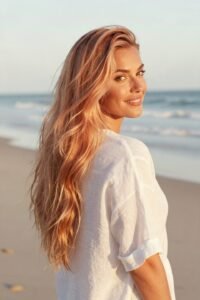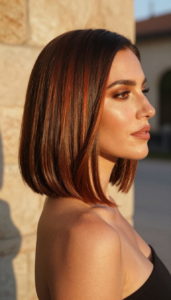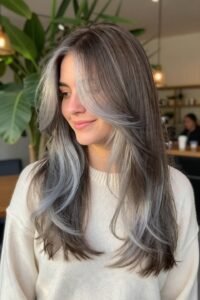
Strawberry blonde is less a single shade than a spectrum. Lean it toward apricot and it reads soft and sunny. Push it pink and metallic and it turns rose gold. Deepen it toward copper and it glows like late-afternoon light. This collection moves across that range through different lengths, textures and tones, so you can find the version that suits how you actually wear your hair.
Apricot-Peach Waves with a Deeper Strawberry Root
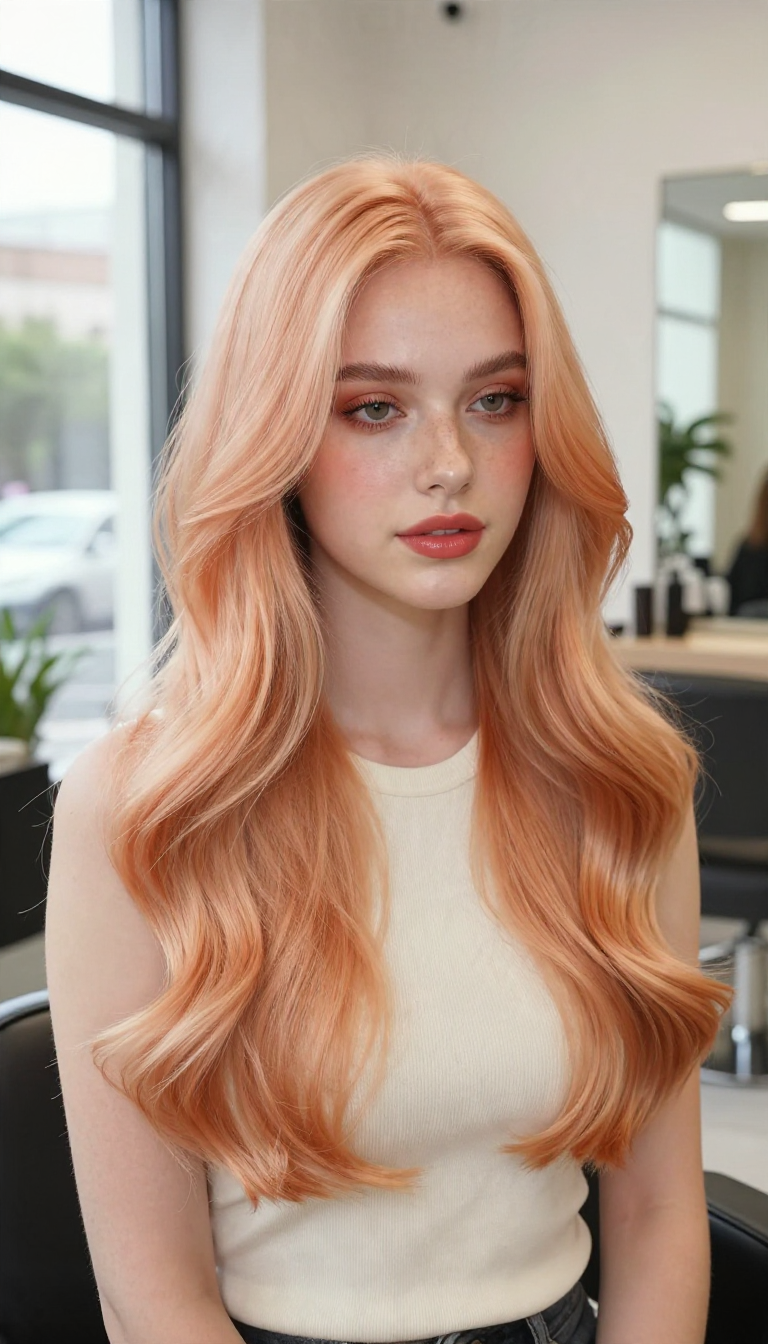
The color here is a soft apricot-pink with lighter golden-peach pieces running through the mid-lengths and ends. The roots stay a touch warmer and deeper, so the shade reads as dimensional rather than flat. The long hair falls past the chest in loose, glossy waves with a center part, and the lighter strands catch the window light along each bend of the wave.
This look depends on subtle contrast. If you want it, ask your colorist for a peachy strawberry that stays warm instead of drifting orange, and mention that you like a slightly deeper root for a lived-in grow-out. Keeping the waves loose and polished, with a smoothing serum on the ends, helps the pastel tones look luminous. Peachy tones can soften over time, so ask about a color-safe shampoo and a gloss refresh schedule that suits your shade.
Rose Gold Blunt Lob with Mirror-Gloss Shine
Here the color is the cut's best accessory. A collarbone-length lob with a sharp, blunt edge is washed in pale golden blonde with a pink-copper, almost metallic sheen. The hair is smooth and straight from the part to the ends, with one side tucked neatly behind the ear. That tuck exposes the long, uninterrupted line of the cut and lets the light slide down it.

Rose gold shows its best on hair that reflects light evenly, so shine is as important as shade. When you book, bring the word "blunt" for the cut and "rose gold with a golden base" for the color, so the pink doesn't turn cool or candy-like. Flat-ironing in small sections and finishing with a lightweight shine product keeps the surface mirror-smooth. A blunt lob also looks its sharpest when trimmed regularly, so plan for frequent trims to hold the clean edge.
Honey-Peach Balayage Curls from Behind
Seen from the back, the idea is all about transition. The hair begins with a soft strawberry-copper shadow at the roots and melts into glowing peach-gold ribbons through the mid-lengths and ends. The loose, bouncy curls reach mid-back, and each curl shows that gradual shift from deeper tone to brighter tip, so the color seems to move along with the hair.
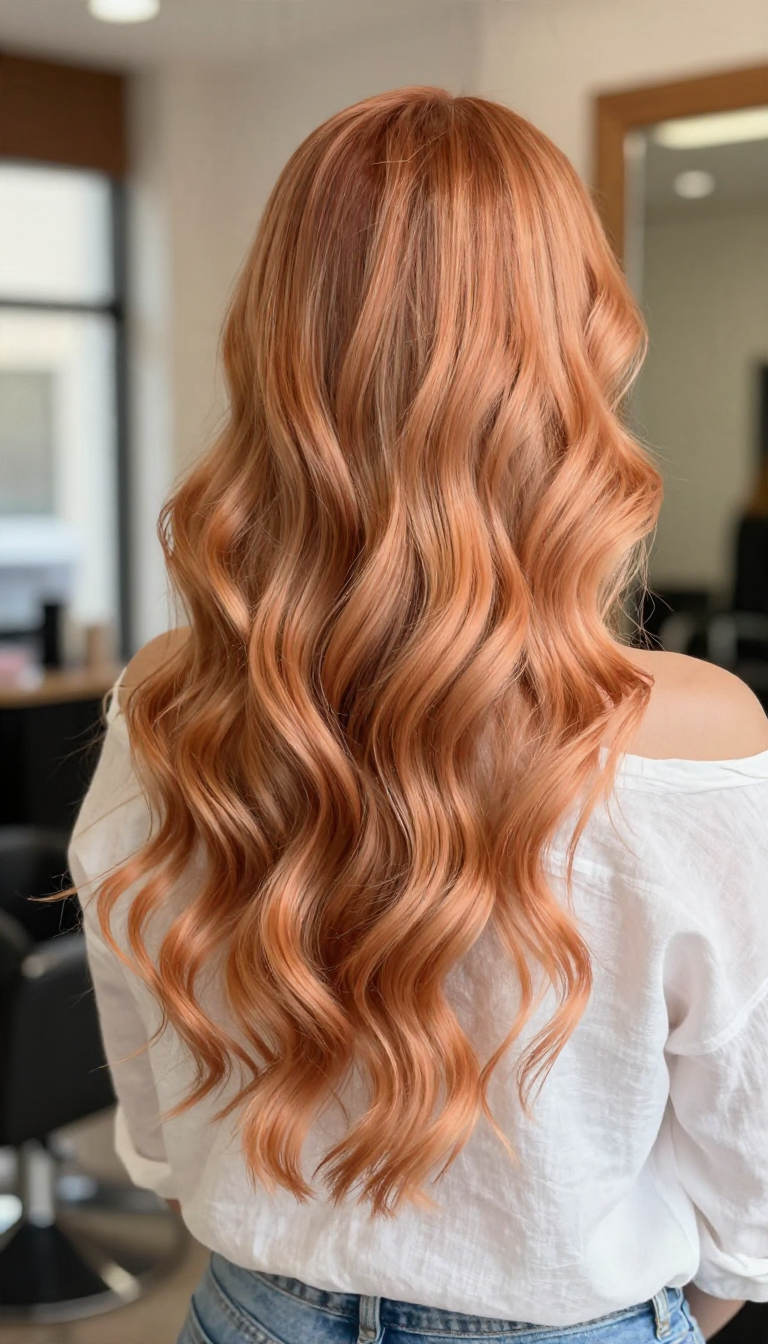
A balayage like this grows out gently because there's no hard line at the root. If you're considering it, ask your stylist about a diffused shadow root and brighter peach through the lengths rather than stark, high-contrast streaks. Large, loosely set curls, brushed out slightly, display the ribbons of color best, and tighter curls can compress the tonal shift. A heat protectant is a smart addition when curling, since warm, bright pieces can look dull when the ends are dry.
Pale Strawberry Blonde Bob with a Pink-Peach Wash

This is the most delicate take on strawberry blonde. The base is creamy golden blonde with a slightly warmer tone at the part, and the pink-peach appears mainly through the ends and the pieces framing the face. The chin-length bob has a glossy finish and a gentle inward bend at the ends, so the blush tone gathers at the hemline like a soft watercolor wash.
Because the strawberry is concentrated at the lower lengths, this look suits anyone who wants a hint of color without committing their whole head. Ask for a "pink-peach wash through the ends" and show your stylist how far up you'd like it to travel. Blonde that light needs gentle care: purple shampoo can neutralize the warmth, so use it sparingly, and rely on a hydrating mask to keep the ends smooth, since the pastel tones show every bit of dryness.
Copper-Leaning Strawberry Curls with Apricot Highlights
Strawberry blonde gets its richest, most fiery expression here. Defined, springy curls sit just past the shoulders, with a strawberry-copper base and bright apricot and honey ribbons scattered through each coil. Backlit by low sun, the lighter pieces glow while the deeper copper adds depth, and the halo of loose strands around the edges makes the whole shape look luminous.
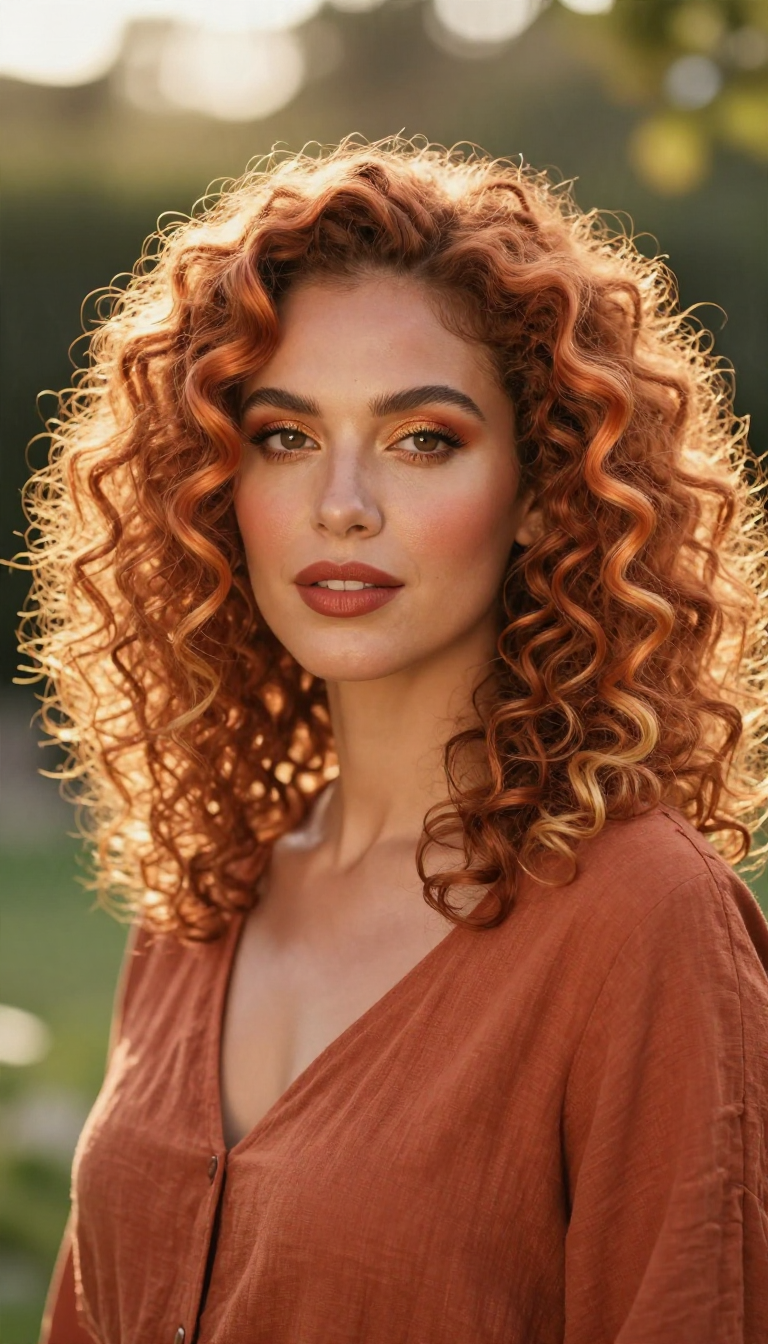
With tight curls, placement matters more than quantity, since highlights on a coil show up in small, repeated flashes. Ask your colorist to scatter apricot and honey pieces through the curl pattern, rather than concentrating them in big chunks, so each ringlet carries a bit of both shades. Moisture is the priority for color like this. A leave-in cream and a curl-defining product applied to wet hair, then air-dried or diffused, will help keep the coils bouncy and the warm tones looking rich.
Glass-Straight Rose Gold with a Blush-Pink Cast
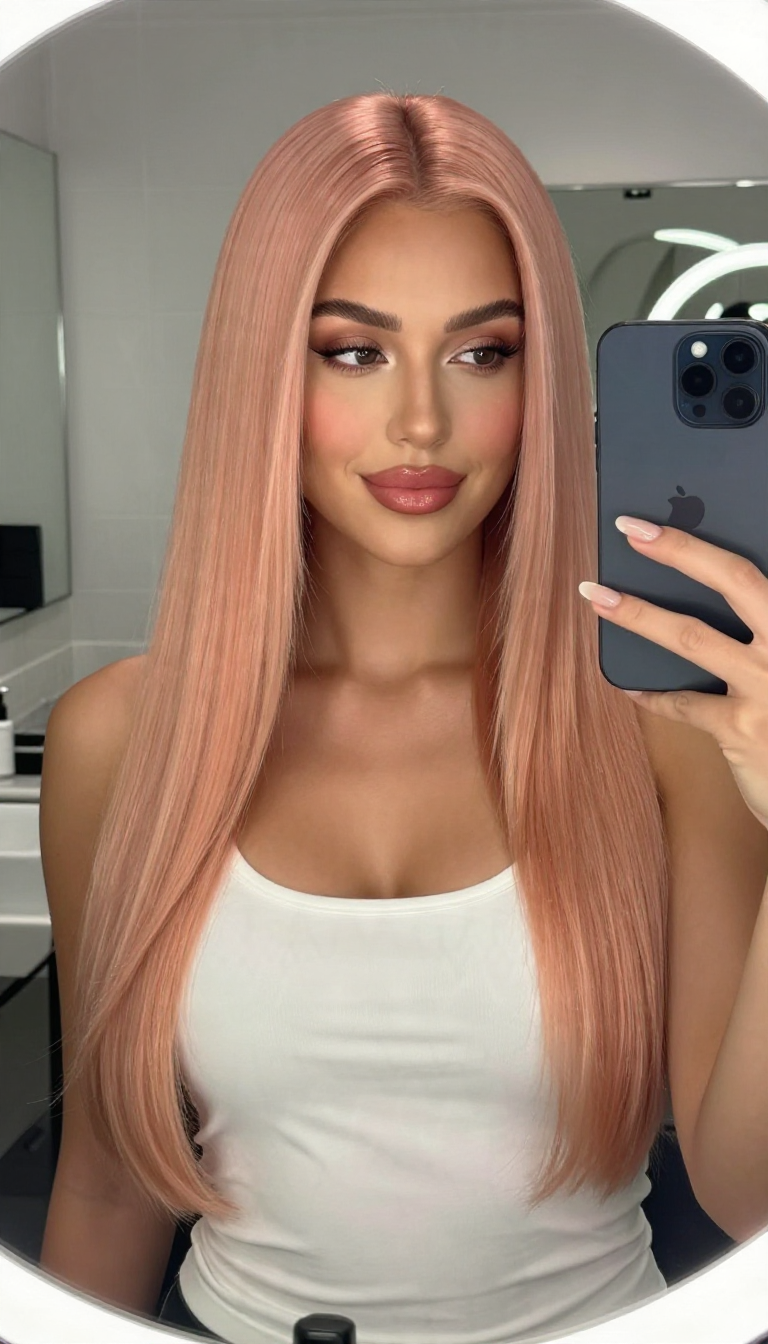
Rose gold reads most clearly when nothing interrupts it, and this is the purest version of that idea. The hair is long, ruler-straight and parted dead center, so the color is displayed as one uninterrupted sheet. The base is a soft pink-peach with a faint copper warmth, and a few lighter golden-peach strands catch the ring light along the lengths. The shade stays remarkably even from the part to the ends, with only a subtle deepening right at the root.
Because the finish does so much work here, the look depends on smoothness. A center part and a single length mean any frizz or dryness would show immediately, so it helps to ask your stylist about a shine-focused finishing treatment or a lightweight smoothing serum for daily use. Pastel-leaning pinks tend to be the first tones to soften, so when you book, describe the goal as "rose gold with a blush undertone, not orange and not bubblegum." Bring a photo, since the line between peachy and pink is narrow. Keep any flat-iron passes slow and at a moderate temperature to protect the polished look.
Peach-Blonde Money Piece and Curtain Bangs on Layered Strawberry
The face is the frame in this one. Wispy, center-parted curtain bangs sweep outward on both sides, and the strands around them are noticeably brighter, a luminous peach-blonde that lifts the complexion while the rest of the hair settles into a warmer, deeper strawberry-peach through the back and crown. That contrast between the bright front pieces and the richer body is what gives the color its dimension without needing a dramatic transition anywhere else.

The layers are long and sliced into the lengths, so the ends flick and taper rather than hang in a single blunt line, which keeps the weight light around the collarbone and below. If you want to recreate it, mention three things to your stylist: the bang shape (soft, parted and long enough to blend into the sides), the placement of the brighter pieces (concentrated at the front so they stay visible when the bangs are parted), and how much deeper you want the back to sit. Bangs this fine get oily at the hairline faster than the rest of the hair, so a quick dry-shampoo refresh at the front between washes can be more useful than washing everything.
Dusty Rose Pixie with Piecey Texture
Short hair changes how color behaves, and a pixie shows off every tonal shift at close range. Here the hair is a dusty rose-peach with golden warmth, and the roots sit slightly deeper, so the color looks dimensional even across a small amount of hair. The top is cut in choppy, separated pieces that point in different directions, a longer fringe sweeps across the forehead, and the sides and nape taper close, with a slightly longer piece curling behind the ear.

The separation is what makes the shade glow: each piece catches light on its own, so the pink reads brighter at the tips than in the shadows beneath. To get it, ask for a textured pixie with a longer swept fringe and a tapered nape, and be clear that you want the color to keep a slightly deeper root rather than a flat, uniform tone. A light styling paste or clay worked through dry hair with your fingertips defines the pieces without stiffening them. Short cuts grow out visibly, so expect to book trims more often than you would for longer lengths if you want the nape and fringe to keep their shape.
Peach-Sorbet Side Braid with Tones That Twist Together
A braid does something a loose style can't: it forces every tone in the hair to sit side by side. Here, a long side braid hangs over one shoulder and shows the whole color story in one column. The crown is a rosy, strawberry-pink shade, the mid-lengths warm into a soft coral-peach, and the tapering ends lighten to a golden apricot. Because the plaits are slightly loose and pulled a little wider rather than cinched tight, each section catches a different mix of pink and gold.

The finish is soft and slightly undone: the braid is tied off with a small light elastic, a few wisps escape near the face, and the hair at the crown is smooth with a gentle lift rather than slicked flat. That relaxed construction suits a pastel-leaning color, since sharp, tight styling can make delicate shades look flat.
When asking for this look, describe the gradient rather than a single shade. Something like "rosy at the root area, peach through the middle, light golden-peach at the ends" gives a colorist a clear map. If you plan to braid often, mention it, because a braid hides the roots and the lengths differently than loose hair does. To get the same effect at home, braid on dry, lightly smoothed hair and gently tug the edges of each section outward after finishing. Sleeping in a loose braid can also keep pastel hair from tangling, though a silk or satin hair tie is kinder to the ends than a snug elastic.
Defined Copper-Strawberry Twist-Out with Peach-Gold Tips
Volume is the first thing you see here, and the color is what makes it glow. A shoulder-length natural twist-out has been stretched into defined, springy coils that fan out around the face, and the shade is a deep strawberry-copper through most of the hair, with peach-gold brightening the tips and outer edges of the ringlets.
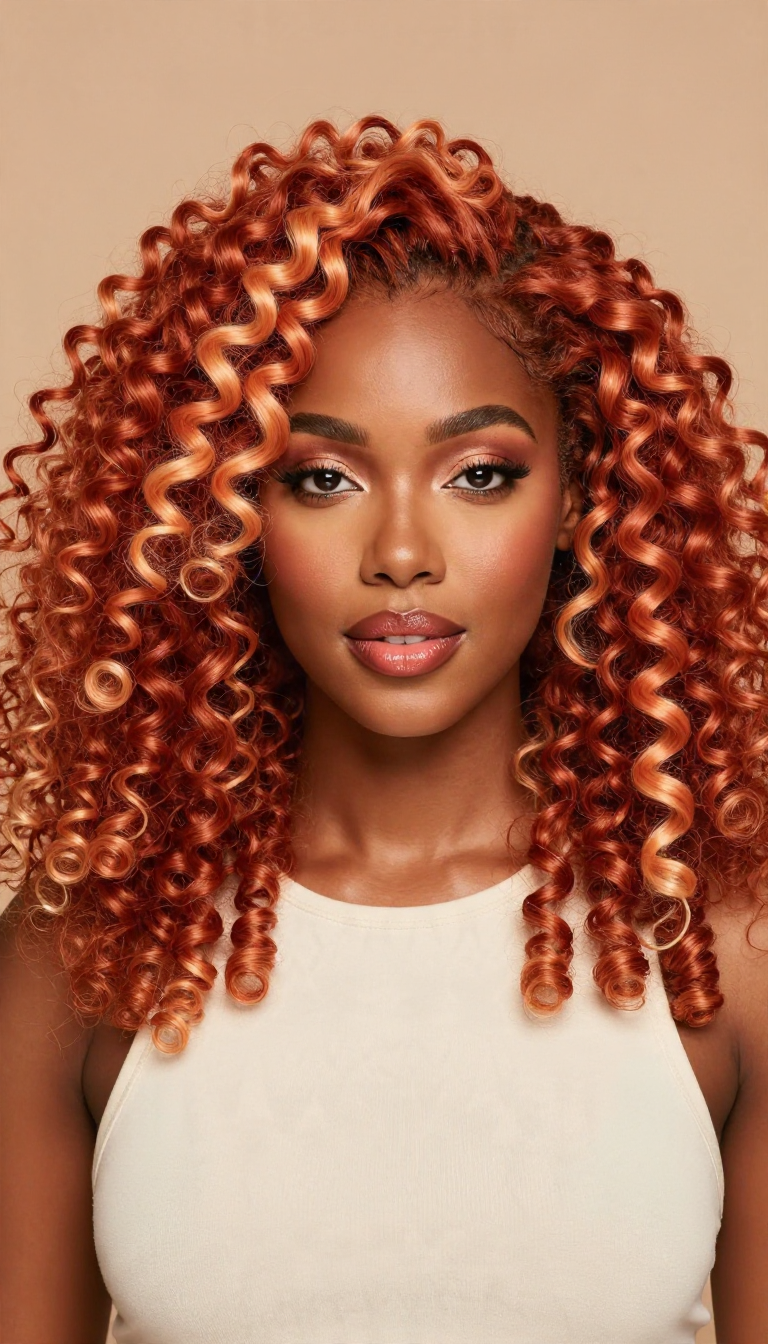
That two-tone effect is what keeps the color from reading as one flat red. Light catches the lighter peach-gold on the outer curves of each coil while the deeper copper sits in the shadowed inner spirals, so the whole head looks dimensional. The sheen across the coils also suggests the hair is well moisturized, which matters a lot for warm shades that can look dull when the strands are dry.
If you want this on textured hair, talk to your colorist about how much lightening your hair can comfortably take, since brighter peach-gold tips usually mean more processing than a copper base alone. Ask whether the lighter tones can be concentrated on the ends and the outer layers, so the root area stays deeper and healthier. Afterward, a twist-out holds its definition best when you set it on damp, product-coated hair, let it dry completely, and separate the twists gently with a little oil on your fingertips. Pull the coils apart slowly rather than all at once to keep volume without frizz.
Champagne Strawberry Blonde with a Whisper of Rose
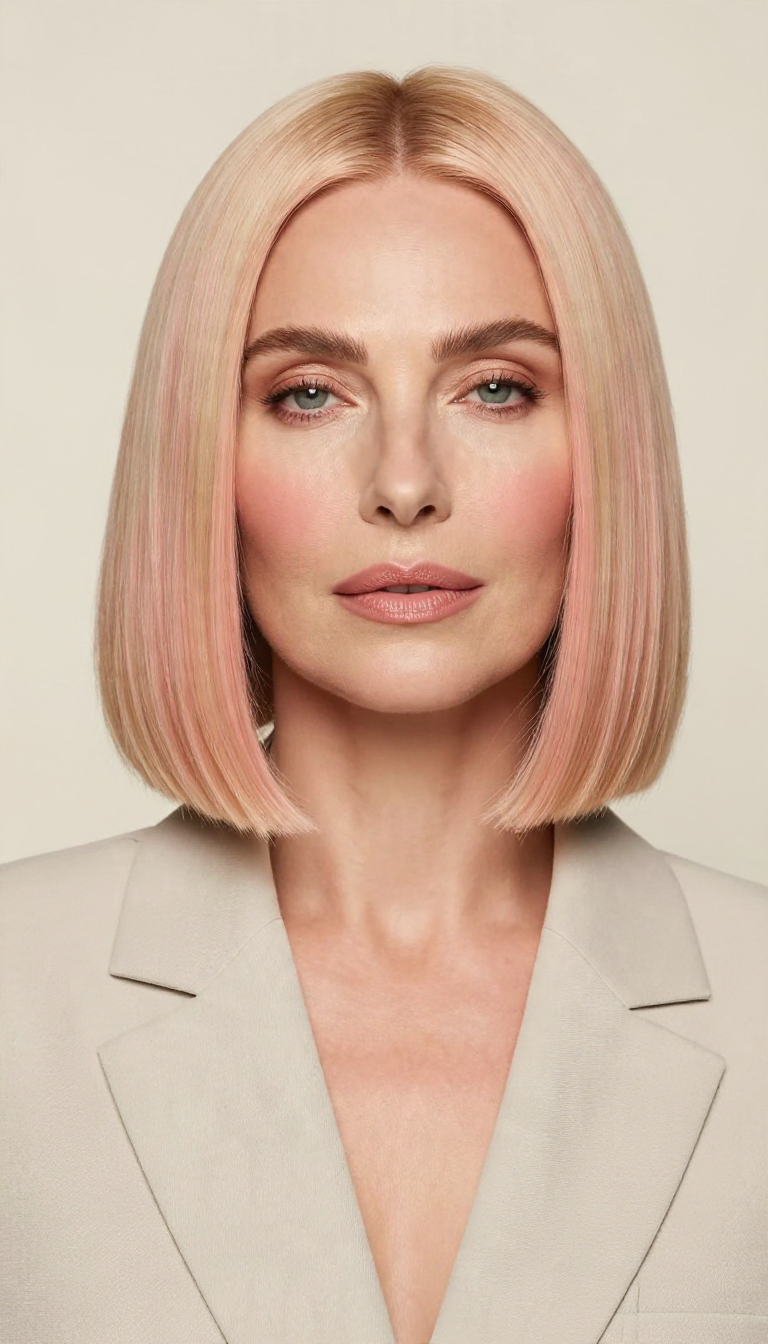
Restraint is the whole point of this shade. The base is a creamy, golden champagne blonde, and the strawberry shows up only as a pinkish-peach tint that gathers toward the lower lengths and along the sides, where it reads as faint ribbons rather than defined streaks. At the center part, a slightly deeper honey tone sits at the roots, so the color looks grown into the head rather than laid over it.
A blunt, shoulder-grazing cut with a clean middle part suits this kind of color because the straight, even lines let the tonal shifts show up without competing with layers. If you want this look, ask your colorist for a champagne or light golden blonde with a sheer rose-peach tint instead of a full strawberry shade, and bring a photo that shows how pale you want the pink to be. Softer tints like this tend to fade gradually, so a conversation about how often you would like to refresh them is worth having. Keeping your roots a touch warmer than the lengths, as they appear here, can also make regrowth less obvious.
Rose Gold to Peach Ombré on Waist-Length Hair
Long hair gives a gradient room to unfold, and this one uses nearly every inch. The roots begin in a muted rose-brown, then the color warms into a true strawberry blonde through the middle, and finally brightens into glowing peach-gold at the tips. Nothing stops abruptly; the shift is gradual enough that you can't point to where one shade ends and the next begins.
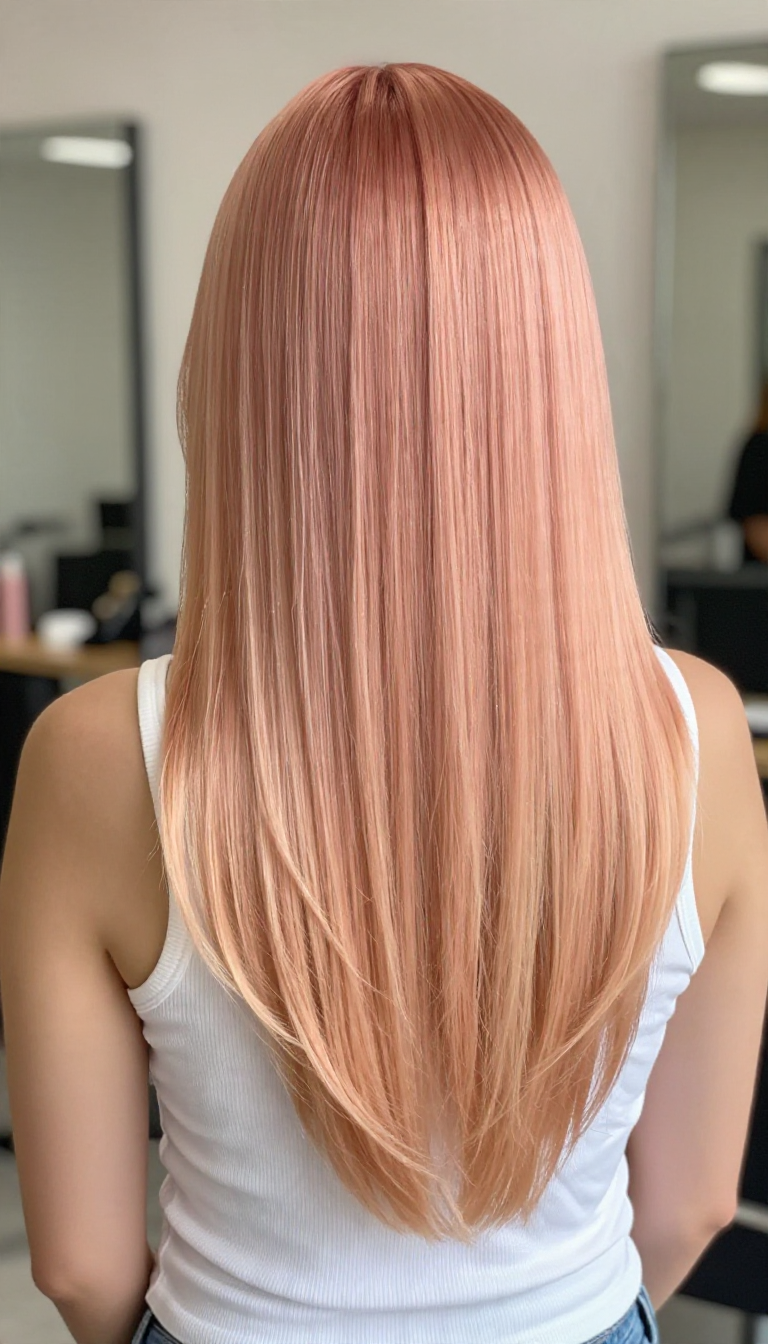
The cut also helps. The ends come to a soft V-shape at the back, with finer, lighter strands trailing off the point, which lets the palest peach tones disappear naturally instead of finishing in a hard line. When you ask for this, the words to use are a soft, blended ombré with a rose-toned root, and it helps to say you want the lightest color concentrated at the ends. Because the darker root is built in, you can go a long time between color appointments, and the main upkeep is protecting the lighter ends. A heat-free dry-down on wash days and a weekly deep conditioning mask will keep the tips looking glossy rather than frayed.
Wet-Look Copper-Rose High Ponytail
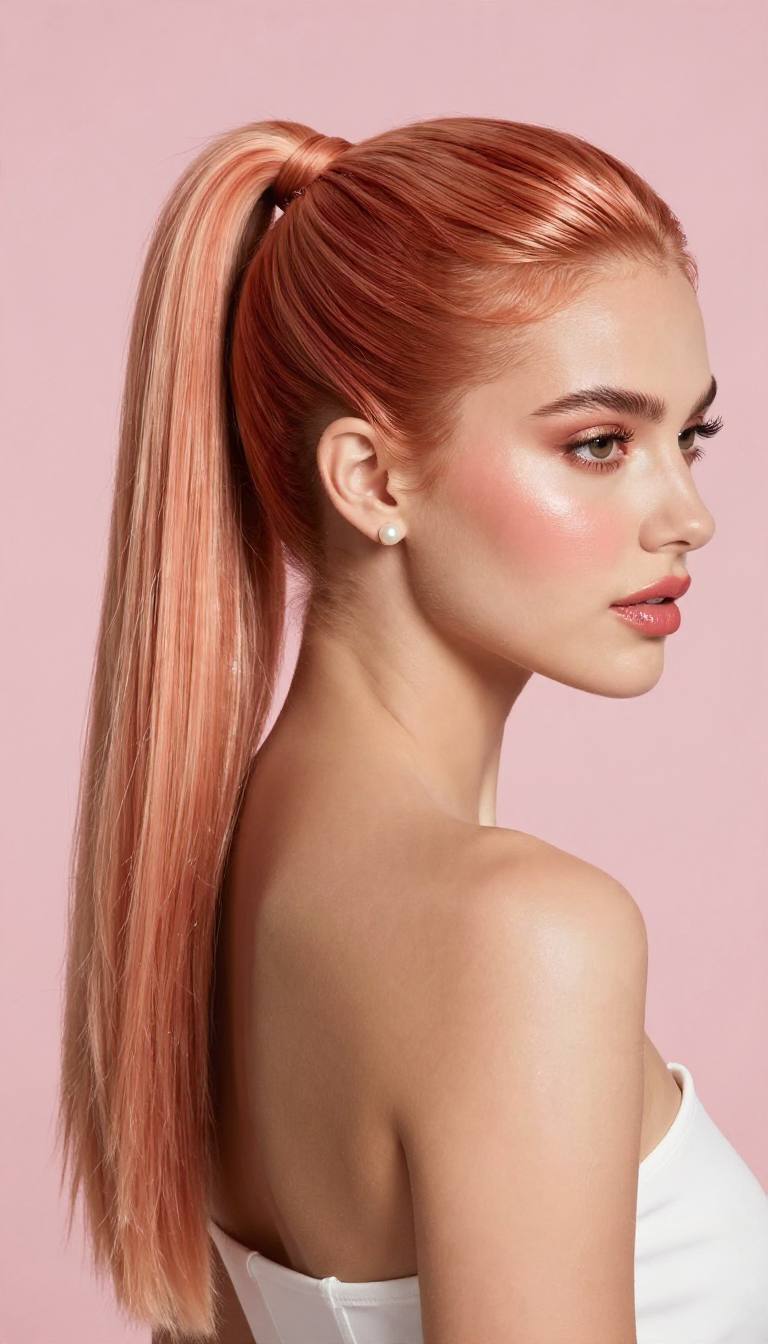
A high, slicked ponytail is a showcase for the deeper end of the strawberry range. The hair pulled tight over the crown is a rich copper-rose, and as it sweeps into the tail, brighter peach-gold strands appear through the length, so the ponytail looks lighter and more luminous than the base. The glassy shine is what holds it together, because the smooth surface reflects light in broad bands across the crown.
The structure here is simple: a clean, close pull to the crown, with a small piece of hair wrapped around the elastic to hide it. For the sleekest result, smooth the hair with a boar-bristle brush while it is slightly damp and finish with a light gel or pomade on the hairline, then a brush-through of a lightweight shine spray along the tail. If you're talking to a colorist, ask about adding fine peach-gold pieces through the lengths while keeping the roots deeper, since that contrast is what gives the tail its dimension when it swings. A pull this tight can be hard on the same strands day after day, so consider moving the ponytail up or down a little between wears.
Apricot Shag with Wispy Curtain Fringe
Here the color and the cut are doing the same job: creating movement. The hair is a warm apricot, closer to peachy orange than pink, with golden honey pieces catching in the choppy layers and a faint rose undertone at the ends. The wavy shag layers are visibly uneven, so the lighter strands fall in different places and the color seems to shift each time the hair moves.
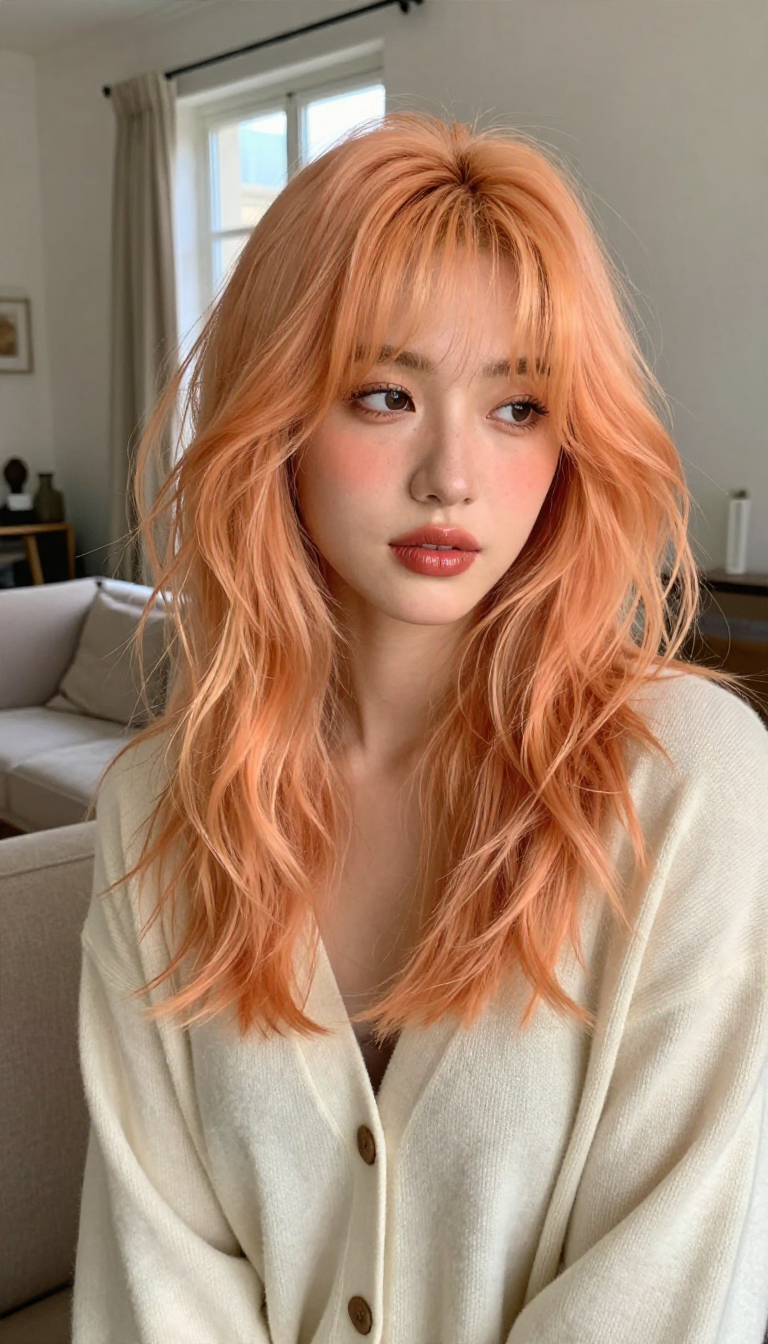
The fringe is thin and parted in the center, so it lets some skin show through while the apricot color sweeps outward along the cheekbones. If you like this look, tell your stylist you want a shaggy, face-framing cut with plenty of internal texture rather than a clean, weighted shape, since the tousled layers are what create the dimension. Warm, orange-leaning shades like this tend to be vivid, so ask how your colorist would keep the golden pieces from flattening out as the color settles. At home, scrunching a sea-salt spray or a light texturizing cream into damp hair and air-drying will keep the waves loose and lived-in.
Soft Rose Gold Half-Up with Loose Waves
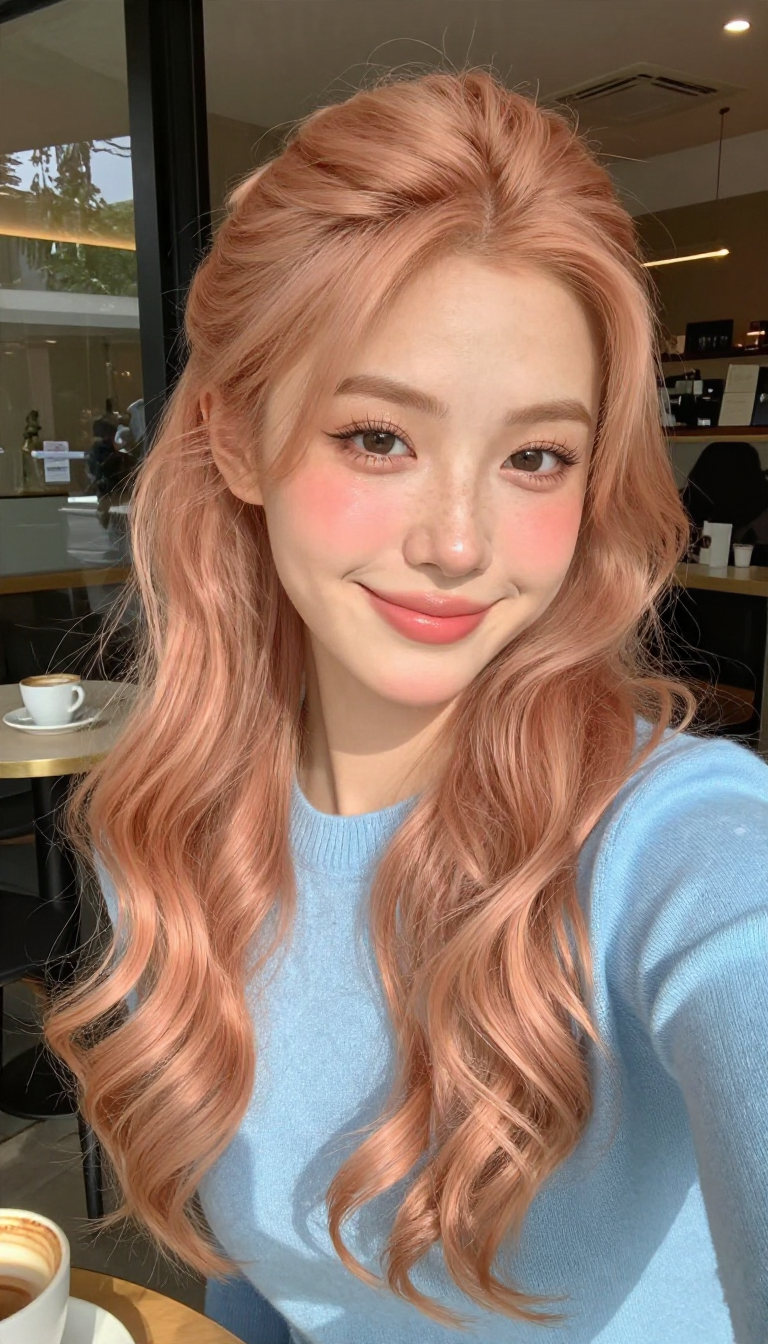
Half-up styling is where this rose gold looks most approachable. The color is pink-gold with warm peach lights, and it sits closer to a polished copper-pink than a pastel. The top section is gathered back with a bit of height at the crown, while the lower lengths fall past the shoulders in smooth, rounded waves that show off the tone on every curve.
The curls are loose and uniform rather than tousled, which gives the shade a glossy, finished feel, and the way the sunlight catches the front pieces shows how much warmth the peach highlights add. To recreate it, curl the lengths in large sections with a medium-barrel iron, all in the same direction, then brush them out gently so the waves blend. Gather the top section loosely and pin it low enough to leave some height. Pink-gold shades look best when the peach is clearly present, so it is worth asking your colorist for a few warmer highlights rather than a single flat rose tone. That way the half-up shape has something to catch the light.
Strawberry-Gold Foilayage with Brushed-Forward Shine
Fresh from the chair is when a color looks its most honest, and this one holds up under salon lighting. The base reads as a soft, warm strawberry-copper at the crown. Fine strands of pale golden blonde and peachy pink run through it, and the brightest pieces frame the face, where a wide butter-yellow streak sweeps back from the temple. Toward the lower lengths the whole palette lifts into rosy peach and apricot, with a slightly deeper orange tone at the very tips.
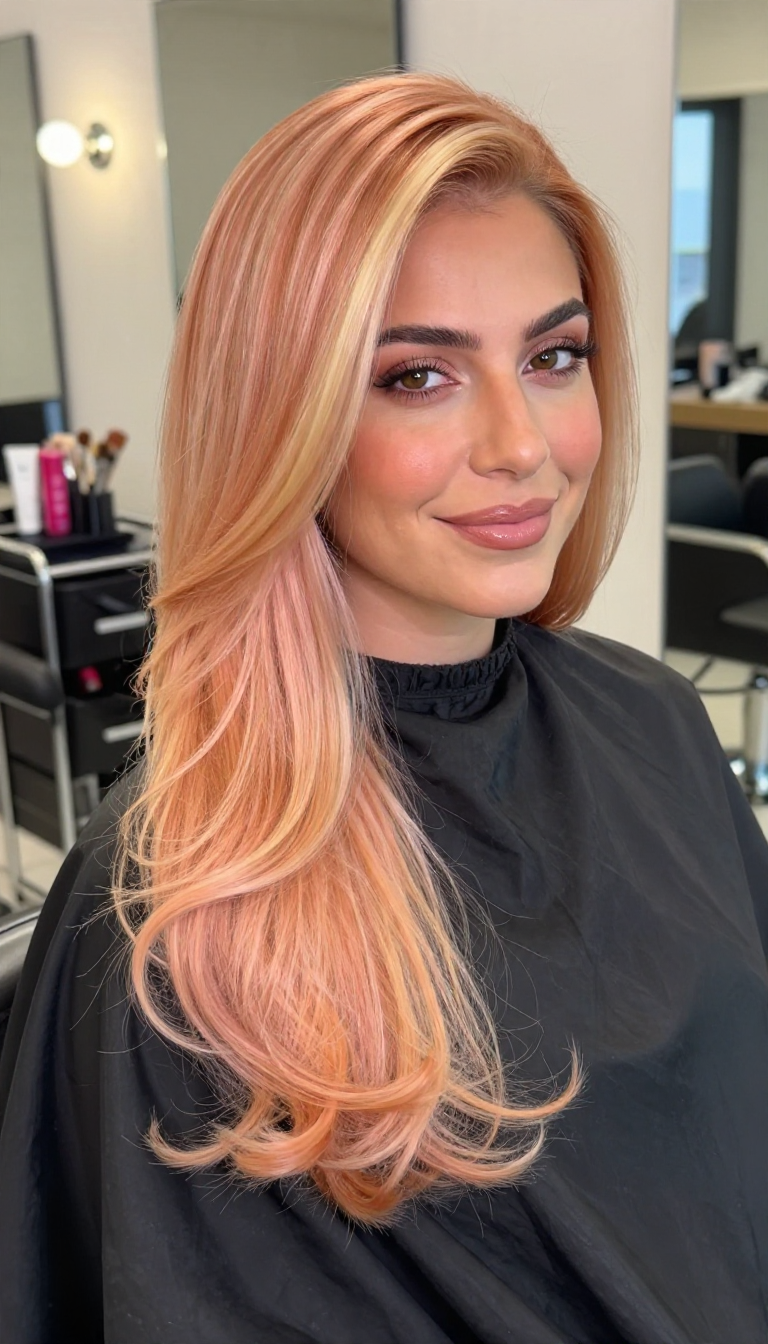
What makes it distinctive is how thin and scattered the lighter pieces are. Instead of chunky stripes, the highlights look hand-painted and fine, so the strawberry base keeps showing between them and the overall effect stays blended rather than banded. The color seems to start close to the scalp without a hard line, then brighten gradually as it travels down. The soft, layered shape and the gentle curl at the ends give the color some movement and make the glossy surface catch light in different places.
If you want this, ask your colorist for a foilayage-style result: hand-painted, soft-focus lightness on a strawberry base, with the root left close to your natural depth or the base shade so regrowth stays easy to live with. Bring a photo and be specific about the end tone you prefer, whether more peach, more pink or more golden, because the lower lengths here lean peachy-rose and that is the part most easily nudged one way or the other. Warm-toned lightness tends to show best on a smooth, healthy surface, so ask whether a bond-support step is sensible if your hair has been lightened before. At home, a quick pass with a medium-barrel round brush or hot-roller set on the ends is a simple way to get that tucked-under shape. A face-framing brightness like the wide front piece is also a low-commitment spot to start if you would rather test the color before going all over.